

Certificado digital electronic identification certificate
Spanish bureaucracy has a reputation, and not always a flattering one.
But here’s the secret weapon that turns the entire system from an analogue nightmare to a digital convenience: the certificado digital.
This electronic certificate is your ticket to signing documents, filing tax returns and completing high-security administrative tasks without leaving your home in Malaga.
What is the certificado digital?
The certificado digital (digital certificate) is a secure electronic certificate issued by the Fábrica Nacional de Moneda y Timbre – Real Casa de la Moneda (FNMT-RCM), Spain’s national mint.
The certificate lives on your browser or device and functions as a digital identity card or electronic signature, automatically proving who you are in online processes.
Unlike Cl@ve, which is essentially a secure login system, the certificado digital carries legal weight as an actual signature.
When you need to sign a contract, submit your tax return (declaración de la renta), or complete any official procedure that requires your legal signature, the certificado digital is what makes it valid.
For expats in Malaga and across Andalucía, this means you can handle serious legal and financial matters without visiting government offices in person.
It’s particularly crucial during tax season when everyone in Spain simultaneously remembers they need to sort out their finances.
Who can get the certificado digital?
Good news for foreign residents: you don’t need to be a Spanish citizen to obtain a certificado digital.
Anyone with a NIE (Número de Identidad de Extranjero) or Spanish DNI can apply for one.
This includes British expats, EU citizens and non-EU residents with legal residency status in Spain.
The key requirement is having your NIE already sorted, as you’ll need this identification number throughout the application process.
You’ll also need a valid email address and, for the verification stage, either a way to attend an in-person appointment at a registration office in Malaga or access to the video verification service.
If you’ve got your residency paperwork in order, the certificado digital is within reach.
How to get the certificado digital: Step-by-step guide
The process involves submitting an online request, followed by identity verification, and then downloading and installing your certificate.
Here’s how it works:
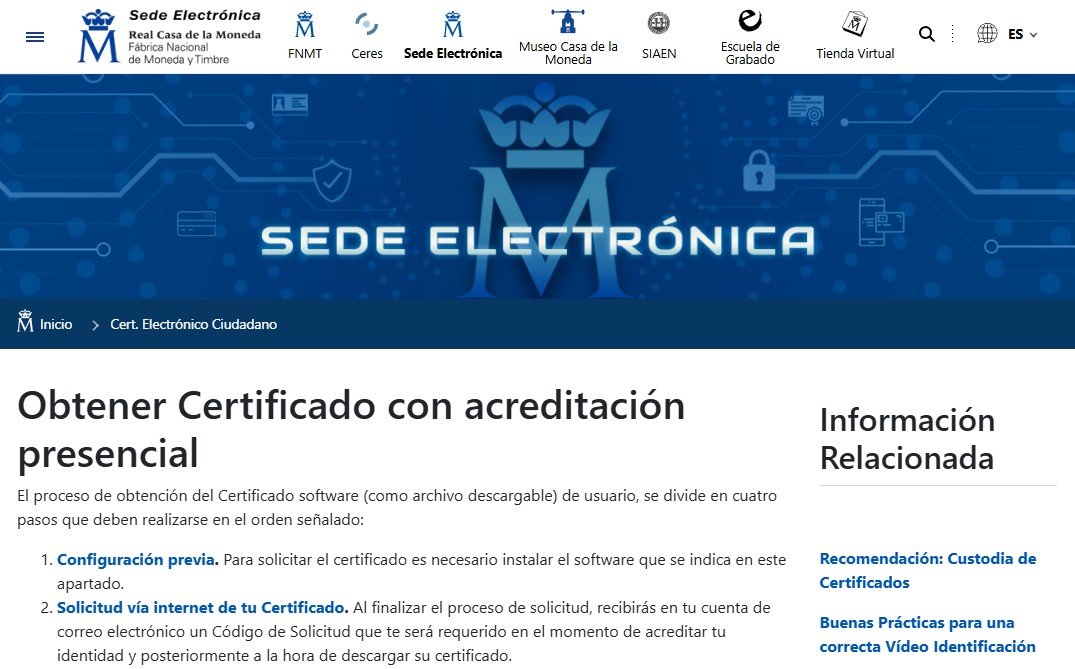
- Go to the FNMT certificate request page
- Under ‘¿Cómo puedo obtener el Certificado?’ (How can I get the certificate?), choose which option best suits you
- Video verification: Book an appointment through the online video service
- In-person verification: Find your nearest registration office
- Electronic DNI: Use your card reader if you have the Spanish electronic ID card
- Follow each step provided, starting with the installation of the software
- Fill in your NIE or DNI number, name and email address to generate your certificate request
- Save the verification code they provide (you’ll need this later)
- Complete the corresponding identity verification within 10 days of making your request
- Return to the FNMT download page and enter your verification code
- Enter your verification code and download the certificate
- Install the certificate on your browser (Chrome, Firefox or Safari)
- Export and back up your certificate to a secure location – if your computer dies, you’ll need to start the entire process again.
The certificate is valid for four years, after which you’ll need to renew it.
What can you do with the certificado digital in Malaga?
The certificado digital unlocks the more powerful administrative functions that require legal signatures.
You can file your annual tax return (declaración de la renta) with the Spanish tax authority, which is compulsory for most residents and significantly easier to file online than to queue at the tax office.
You can digitally sign contracts, rental agreements or other legal documents with full legal validity.
You can access and download official documents from various government departments, register or modify business activities if you’re self-employed (autónomo), and handle property-related paperwork, including buying, selling or registering property in Andalucía.
You can also apply for grants, subsidies or official certifications, and complete high-security immigration procedures.
Essentially, if it’s official and requires your signature, the certificado digital allows you to sign it online.
Certificado digital vs Cl@ve: Which do you need?
Here’s the practical truth: most long-term residents in Malaga end up getting both.
Cl@ve is perfect for everyday administrative tasks, like checking your Social Security account or viewing tax information.
The certificado digital is essential for tasks requiring digital signatures or high-security submissions.
Different government portals have different requirements, and some accept either, while others demand specifically one or the other.
Having both means you’ll never hit a bureaucratic brick wall because you’ve got the wrong digital credential.
The good news is that once you’ve got your NIE and padrón sorted, setting up both systems is relatively straightforward.

The Malaga Guru team comprises individuals of diverse ages and backgrounds who share a common bond – a deep affection for the city of Malaga, its rich culture and its warm-hearted inhabitants!